Play Mega Joker Now!
Home → Strategy
Mega Joker Strategy
Approaching Mega Joker sensibly
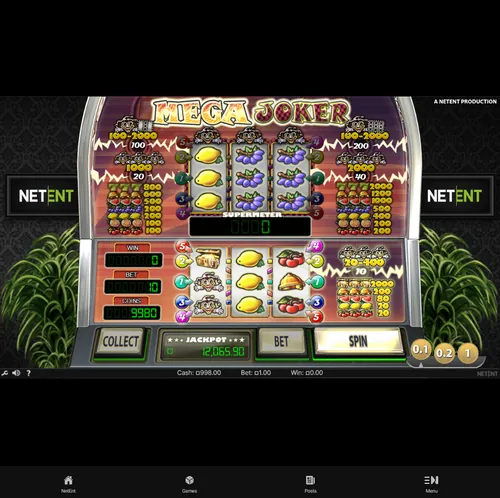
Mega Joker is an online slot developed by NetEnt, released in 2008 with a theoretical return of 99.00% over a very long run, meaning the house edge stands at exactly 1.00%. This high RTP figure suggests that consistent play can theoretically preserve capital better than lower-return games, provided the player understands the mechanics. The game features classic fruit-machine symbols and five paylines across three reels, creating a simple visual interface that contrasts with its complex backend mathematics. Players should note that this 99.00% figure is only achievable under specific betting conditions within the Supermeter mode.
The maximum win potential for Mega Joker is capped at 200x the stake, which significantly limits upside compared to modern video slots like Gonzo's Quest that offer 2,500x max wins. This lower ceiling reflects the game's focus on steady returns rather than massive jackpots, appealing to players who prefer predictable variance over lottery-style payouts. While other NetEnt titles such as Divine Fortune provide a 1000x cap, Mega Joker's structure prioritizes the Supermeter gamble feature to extend gameplay duration. Understanding this limitation helps manage expectations regarding the frequency and size of significant wins during a session.
Unlike live dealer tables, Mega Joker operates entirely on random number generation without any human interaction or real-time dealer oversight, ensuring pure algorithmic randomness. The absence of free spins means all engagement relies on the base game and the progressive jackpot trigger, which occurs randomly without player input. This design choice simplifies the experience but removes common bonus features found in newer releases like Starburst, which uses expanding wilds instead. Consequently, the player must rely solely on the 99.00% RTP expectation to guide their long-term bankroll management strategy effectively.
Bankroll rules that hold up
A bankroll represents the money set aside specifically for play, and for Mega Joker, it must withstand the volatility inherent in its very high risk profile. With a maximum win of only 200x, large swings are unlikely but possible due to the high volatility setting established by NetEnt in 2008. To survive these fluctuations, a player needs a substantial reserve relative to their bet size, ensuring they do not deplete funds during dry spells. This financial buffer is critical because the game does not offer frequent small wins to sustain interest between larger payouts.
The theoretical return of 99.00% applies over hundreds of thousands of spins, implying that short sessions will likely deviate significantly from this average. For instance, if a player bets €0.20 per spin, the expected loss per hour depends heavily on the speed of play and the specific mode engaged. Unlike flat betting strategies used in low-volatility games, Mega Joker requires careful monitoring of the Supermeter balance to prevent rapid erosion of the total bankroll. This mathematical reality necessitates strict discipline in tracking losses against the initial deposit amount accurately.
Other NetEnt titles like Dead or Alive offer higher volatility with an 8,600x max win, allowing for different bankroll management approaches focused on chasing big hits. Mega Joker's 200x cap and 99.00% RTP suggest a more conservative approach where preserving the bankroll is paramount for extended playtime. A player might allocate a specific portion of their total funds to cover the cost of entering the Supermeter mode repeatedly. This allocation ensures that the pursuit of the progressive jackpot does not prematurely end the session due to insufficient remaining balance.
Bet sizing against volatility
Mega Joker exhibits very high volatility, meaning wins are infrequent but potentially larger when they occur, especially within the Supermeter mode's double-or-nothing gamble structure. Setting a bet size that aligns with this risk profile is essential, as standard flat betting may drain funds too quickly during losing streaks. The game offers a lowest bet level configuration with an RTP of 76.90%, which is significantly lower than the 99.00% available at higher stakes. Players must adjust their wagers to access the optimal return rate while managing the increased risk associated with higher volatility.
The progressive jackpot is randomly triggered and adds another layer of complexity to bet sizing decisions, as it operates independently of the base game outcomes. Since the maximum win is capped at 200x outside of the jackpot, betting too high can lead to rapid depletion without proportional reward increases. For comparison, Starburst has low volatility and a 500x max win, allowing for smaller, more frequent bets with less risk. Mega Joker's structure demands larger bet sizes to justify the risk, yet remains constrained by its modest overall payout ceiling compared to high-variance alternatives.
Alles Spitze by Merkur shares high volatility with Mega Joker but offers a 500x max win, providing a slightly better risk-reward ratio for aggressive bettors. However, Mega Joker's unique Supermeter feature allows players to raise multipliers through gambling, which directly impacts effective bet sizing during active rounds. A player might start with minimum bets in the base game and increase stakes only after triggering the Supermeter to maximize potential returns. This strategic adjustment helps mitigate the impact of the very high volatility on the overall bankroll health over time.
Session limits worth setting
Given the very high volatility of Mega Joker, setting a strict time limit for each session prevents fatigue-induced errors in decision-making during the Supermeter mode. The game's 99.00% RTP is a long-term average, so short sessions can result in significant deviations from expected returns, requiring disciplined stop-loss points. Unlike live dealer games where social pressure might influence decisions, Mega Joker's automated nature allows for precise control over session duration and spending. Establishing a clear end time helps maintain objectivity when facing the temptation to chase losses after a downturn.
The maximum win cap of 200x means that even successful sessions have a defined upper boundary for profit, making it logical to set a win target before starting. If a player reaches a predetermined profit level, such as doubling their initial bankroll, terminating the session preserves gains against the inevitable regression to the mean. This approach contrasts with games like Divine Fortune, which offer 1000x max wins and might encourage longer play to hit larger payouts. For Mega Joker, securing profits early is a rational strategy given its relatively low maximum win potential compared to other NetEnt releases.
NetEnt's release of Mega Joker in 2008 predates many modern responsible gaming tools, yet self-imposed limits remain crucial for managing the game's high volatility. Players should calculate the number of spins they can afford based on their bet size and the 1.00% house edge to determine a realistic session length. For example, betting €1.00 per spin with a €100 bankroll allows for approximately 100 spins before complete depletion in a worst-case scenario. This calculation provides a concrete metric for setting session limits that protect the player's financial well-being during play.
Why chasing losses fails
Chasing losses in Mega Joker is mathematically unsound due to the fixed 1.00% house edge, which remains constant regardless of previous outcomes or bet adjustments. Progressive staking systems that raise stakes after losses do not alter this built-in advantage and only accelerate the time to ruin by increasing exposure to variance. The game's very high volatility amplifies the risk of rapid bankroll depletion when attempting to recover deficits through larger wagers. Understanding this principle is vital for maintaining a sustainable approach to playing NetEnt's classic slot title.
The Supermeter mode involves a double-or-nothing gamble to raise multipliers, which tempts players to continue risking winnings in hopes of reversing earlier losses. However, each gamble is an independent event with no memory of past results, meaning previous failures do not increase the probability of future success. This misconception leads to irrational behavior where players ignore the statistical reality that the house always retains its edge over the long run. Mega Joker's 99.00% RTP does not guarantee immediate returns, making recovery attempts through increased betting futile and dangerous.
Comparing Mega Joker to games like Dead or Alive, which has high volatility and an 8,600x max win, highlights why chasing losses is particularly ineffective here. Mega Joker's lower 200x cap and simpler feature set offer fewer opportunities for large recoveries, making loss-chasing even more perilous. The absence of free spins means there are no bonus rounds to provide unexpected windfalls that could offset accumulated deficits. Players must accept that each spin is independent and that no betting strategy can overcome the fundamental mathematical disadvantage imposed by the casino.
Mega Joker: key facts
| Parameter | Value |
|---|---|
| Game | Mega Joker |
| Studio | NetEnt |
| Released | 2008 |
| RTP | 99.00% |
| House edge | 1.00% |
| Volatility | very high |
| Max win | 200x |
| Reels | 3 |
| Paylines / ways | 5 |
Common systems and their limits
Mega Joker by NetEnt offers a theoretical return of 99.00% with a house edge of just 1.00%, yet its very high volatility demands patience. This extreme variance means long dry spells between wins, making consistent bankroll management essential for any player attempting to sustain play through downswings. The maximum win is capped at 200x, which significantly limits the upside potential compared to modern video slots that often promise much larger multipliers.
While the game features five paylines across three reels, the Supermeter mode introduces a double-or-nothing gamble that raises the multiplier but also increases risk. Players must decide whether to collect modest payouts or risk them for higher rewards, a mechanic that defines the strategic core of this classic fruit-machine experience. Understanding these mechanics helps players set realistic expectations about how quickly their bankroll might deplete during extended sessions of high-variance gameplay.
Unlike Book of Dead from Play'n GO which boasts a max win of 5000x, Mega Joker’s ceiling is strictly lower at 200x despite its superior RTP. This difference highlights that a high return percentage does not guarantee large individual payouts, as the frequency of hits is generally low due to the very high volatility setting. Players seeking frequent small wins may find this title frustrating compared to medium volatility alternatives like Le Cowboy from Hacksaw Gaming.
Flat betting explained
Flat betting involves wagering the same stake every round, such as 0.20 € per spin on the lowest bet level where the RTP drops to 76.90%. This strategy prevents rapid bankroll erosion by avoiding progressive staking increases after losses, ensuring that each spin carries identical financial risk regardless of previous outcomes. It is particularly useful for managing funds over hundreds of thousands of spins required to approach the theoretical 99.00% return rate accurately.
The absence of free spins in Mega Joker means players cannot rely on bonus rounds to recover losses or boost their balance significantly during a session. Instead, they must depend on standard wins and the Mystery reward feature, which occurs randomly and adds an element of unpredictability to the flat betting approach. This consistency allows for precise tracking of loss rates and helps maintain discipline when facing the inevitable dry spells associated with very high volatility games.
Using flat betting on Big Bass Splash by Pragmatic Play would expose players to high volatility risks similar to those found in Mega Joker, though with different payout structures. However, sticking to a fixed stake ensures that the built-in house edge remains the primary factor influencing long-term results rather than emotional decision-making during losing streaks. This methodical approach aligns well with the mathematical reality that no betting system can alter the fundamental odds established by the game's design parameters.
Progressive staking risks
Progressive staking involves raising stakes after losses, a tactic that drastically shortens the time to ruin without changing the built-in house edge of 1.00%. For example, doubling bets after each loss on Mega Joker might seem logical to recover deficits quickly, but it exponentially increases exposure to the game's very high volatility. This strategy ignores the statistical inevitability of long losing runs inherent in slots with such extreme variance characteristics over extended playing periods.
Comparing this risky approach to the stable mechanics of The Dog House Megaways from Pragmatic Play reveals why flat betting is safer for most players. While The Dog House offers a max win of 12305x, attempting to chase losses through progressive staking on Mega Joker exposes the bankroll to sudden depletion due to its 200x cap. The lack of free spins means there are no natural breaks to reset momentum, making aggressive staking particularly dangerous in this specific title environment.
Players should note that Wild Bounty Showdown by PG Soft features a diamond-shaped layout with varying rows, offering a different structural experience than Mega Joker's simple three-reel setup. Engaging in progressive staking on either game fails to address the core issue: the house always retains an advantage over the long term. Mathematical analysis confirms that increasing wagers during downturns only accelerates the realization of expected losses rather than providing any genuine path to profitability or sustained enjoyment.
What the maths actually allows
With an RTP of 99.00%, Mega Joker theoretically returns 99 cents for every euro wagered over millions of spins, implying a house edge of exactly 1.00%. This figure represents a long-run average calculated across hundreds of thousands of plays, meaning individual sessions will deviate significantly from this expectation due to the game's very high volatility. Players should view this percentage as a statistical boundary rather than a guaranteed outcome for any single visit or limited number of spins played.
The maximum win cap of 200x restricts the potential upside available to players, contrasting sharply with titles like Le Cowboy which offers a massive 25000x multiplier. This limitation means that even during rare winning streaks facilitated by the Supermeter mode, payouts remain relatively modest compared to high-variance competitors in the market. Consequently, players must manage expectations regarding potential earnings, understanding that large jackpots are structurally impossible within this specific game framework designed by NetEnt.
Randomly triggered progressive jackpots add another layer of mathematical complexity, as their occurrence is independent of previous spin outcomes and purely chance-based. These events do not affect the overall RTP calculation but provide occasional spikes in potential returns that break the monotony of standard gameplay mechanics. Understanding these probabilistic elements helps players appreciate why consistent results require patience and adherence to strict bankroll management principles throughout their gaming sessions.
Reading variance honestly
Very high volatility in Mega Joker means that wins occur infrequently but can be substantial relative to the stake, requiring significant patience from participants. This characteristic contrasts with medium volatility options like Le Cowboy, where wins happen more regularly but are typically smaller in magnitude compared to the jackpot potential. Players must accept that long periods without any return are statistically normal and part of the inherent risk profile defined by the game's mathematical structure.
The Supermeter mode acts as a double-or-nothing gamble that raises the multiplier, introducing additional variance into an already volatile base game. When players choose to enter this mode, they risk their current winnings for a chance at a higher payout, further amplifying the swings in their bankroll balance. This mechanic exemplifies how the game combines classic fruit-machine symbols with modern risk-reward dynamics to create a uniquely challenging experience for analytical players.
Unlike Book of Dead which offers a max win of 5000x, Mega Joker’s ceiling is strictly lower at 200x despite its superior RTP. This discrepancy illustrates that high return percentages do not correlate directly with large individual payouts, as the frequency of hits is generally low due to the very high volatility setting. Players seeking frequent small wins may find this title frustrating compared to medium volatility alternatives like Le Cowboy from Hacksaw Gaming which provides more regular feedback loops.
Learning the game in demo first
NetEnt released Mega Joker in 2008 as a three-reel slot featuring five paylines and classic fruit-machine symbols. The theoretical return to player is 99.00%, meaning the house edge remains exactly 1.00% over very long runs of play. This high RTP suggests that consistent practice in demo mode helps players understand the volatility before risking real funds.
The maximum win potential stands at 200x the stake, which is relatively low compared to modern video slots with higher caps. Players should note that the game lacks free spins but includes a Mystery reward feature triggered randomly during base gameplay. Understanding these mechanics in a risk-free environment prepares users for the actual betting experience without financial loss.
Supermeter mode operates as a double-or-nothing gamble where players raise their multiplier by betting winnings back into the game. This unique mechanic increases the complexity of the slot significantly compared to simpler games like Sizzling Hot Deluxe from Novomatic. Practicing this transition from base game to Supermeter mode allows users to grasp the strategic depth inherent in the title.
Adjusting stakes to your budget
A defined bankroll represents the total money set aside specifically for playing Mega Joker across multiple sessions or days. Flat betting involves wagering the same stake every round, which helps manage the very high volatility associated with this NetEnt release. Maintaining consistent bets prevents rapid depletion of funds during inevitable dry spells caused by the game's unpredictable nature.
Progressive staking raises stakes after losses, a strategy that does not change the built-in 1.00% house edge but shortens time to ruin. Since Mega Joker has a maximum win of only 200x, chasing losses through increased wagers is mathematically unsound and dangerous. Users should stick to fixed amounts to ensure their bankroll lasts long enough to potentially trigger the progressive jackpot feature.
The lowest bet level offers an RTP of 76.90% when not in Supermeter mode, which is significantly lower than the theoretical 99.00%. Playing at minimum stakes extends the lifespan of the bankroll while exploring the game mechanics without excessive financial exposure. This approach allows players to identify optimal betting patterns before committing larger sums to the five-payline reel layout.
Recognising a bad session
Mega Joker features very high volatility, meaning wins are infrequent but can be substantial when they occur within the 200x cap. A session showing no returns after several hundred spins indicates normal variance rather than a malfunction or unfair algorithm. Recognizing this statistical reality helps players avoid emotional decision-making and unnecessary impulsive actions during extended periods of non-payment.
The absence of a cash-out button distinguishes Mega Joker from crash games, requiring players to accept outcomes once spins are initiated. If the balance drops below the initial deposit by more than fifty percent, the session likely exceeds prudent risk parameters. Stopping immediately preserves remaining funds for future attempts where luck may align better with the statistical expectations of the game.
Randomly triggered progressive jackpots provide occasional large payouts, but relying on them creates unrealistic expectations for average session results. Comparing Mega Joker to titles like Sweet Bonanza Super Scatter, which offers a max win of 50000x, highlights the modest ceiling of this classic slot. Accepting the 200x limit as the standard upper bound helps maintain perspective on what constitutes a successful gaming period.
Stopping while ahead
Achieving a win near the maximum payout of 200x signals an optimal moment to conclude the current playing session immediately. Continuing to spin after such a significant gain exposes the bankroll to the inevitable regression toward the mean dictated by the 1.00% house edge. Securing profits ensures that the temporary positive variance experienced during the session translates into actual retained capital for the player.
NetEnt designed Mega Joker with a Supermeter mode that doubles or loses winnings, creating a binary outcome structure for each subsequent bet. Walking away before engaging in this risky mode protects accumulated gains from being wiped out by a single unfavorable result. Discipline in recognizing peak moments prevents the common pitfall of giving back earned credits during enthusiastic post-win play.
Unlike Le King from Hacksaw Gaming which offers a 20000x max win, Mega Joker’s lower ceiling makes early termination strategies more effective. Setting a strict profit target equal to the initial bankroll provides a clear numerical goal for ending the session successfully. Adhering to this predefined exit point mitigates the psychological urge to chase higher rewards that statistically do not exist in this specific title.
Responsible play in practice
The theoretical RTP of 99.00% applies over hundreds of thousands of spins, never guaranteeing short-term profitability for individual gaming sessions. Players must recognize that volatility ensures significant swings regardless of the favorable mathematical expectation embedded in the game design. Treating the 1.00% house edge as a permanent cost rather than a recoverable expense promotes sustainable and realistic gambling habits.
Mega Joker lacks free spins bonuses found in other titles like Zeus vs Hades, which has a much lower 96.07% RTP but higher volatility. This structural difference means players cannot rely on bonus rounds to offset losses, making strict budget adherence even more critical. Understanding the absence of these protective features helps users adjust their expectations and manage their bankroll more conservatively during play.
Comparing Mega Joker to Buffalo by Aristocrat Gaming, which has medium-high volatility and a 94.85% RTP, illustrates different risk profiles available in online slots. Choosing Mega Joker requires accepting its very high volatility and lower max win cap of 200x compared to other market options. Responsible players select games matching their risk tolerance and financial limits, ensuring entertainment value outweighs the statistical disadvantage over time.
DemoRTP & VolatilitySymbols & PayoutsBonus FeaturesStrategyBonusesMobileDownload & AppMax WinSimilar GamesReviewFAQSitemap
Mega Joker 2026